
magma
on intellectualizing creativity but trying very hard not to

But if I hope to understand in order to accept things– the act of surrender will never happen. I must take the plunge all at once, a plunge that includes comprehension and especially incomprehension. And who am I to dare to think? What I have to do is surrender. How is it done? I know however that only by walking do you know how to walk and – miracle – find yourself walking.
Clarice Lispector, Água Viva
I read an article in the Atlantic about how we don’t feel emotions in the same way that our ancestors did. The author, published in a ‘prestigious’ ‘magazine’, posits that, though there are six core emotions traceable through history (happiness, sadness, anger, fear, surprise, disgust), the way they were experienced Back Then are distinctly different than they would be Right Now. And this is because a person is a complex net of experiences, anchored in a specific point in time. You need context to react. This context is personal, ancestral, cultural, geographical, political. He goes on to suggest that, because of this, even people living at the very same time, on the very same planet, might experience an emotion completely differently. I was reminded of that bit in Doors of Perception, where Aldous Huxley does mescaline and says something like “people are all islands of consciousness.” (Personally it seems more likely that human beings are planets, not islands, with vast swathes of distance between them. But I digress.)
Last summer when it was very hot and very windy I went to my favorite park to read. In my bag was a secondhand book with self-published vibes that I had found in a cafe in Budapest. In this book, The Living Universe, Duane Elgin explains (with the air of an infinitely patient parent) that, cosmically, we are just the right size. He says that in the grand scheme of things, if we were even an iota larger than we are now, our nervous systems wouldn’t be capable of self-actualization. Any smaller and it’s the same problem.
As wind thundered through my oak-tree umbrella, I glanced out at the park. A seagull stared back with its bright beady eyes and then tried to eat a flip-flop.
When I first read Elgin’s words I was comforted by this whole ‘being just the right size’ thing. But now I’m drinking tea with a tall candle burning and wondering if there is actually a lot of grief in that, being so perfectly cosmically situated. To have a nervous system complex enough to read that quote from Huxley and think – yeah, maybe he’s onto something.
On the winter solstice I was in my apartment under all my duvets when I realized, in a very vivid flash, where I was situated, metaphysically. In my head I saw a piece of paper with a simple black ink drawing on it. There was a dip like a bell curve, and in the center of the curve, at the very bottom, was a black dot.
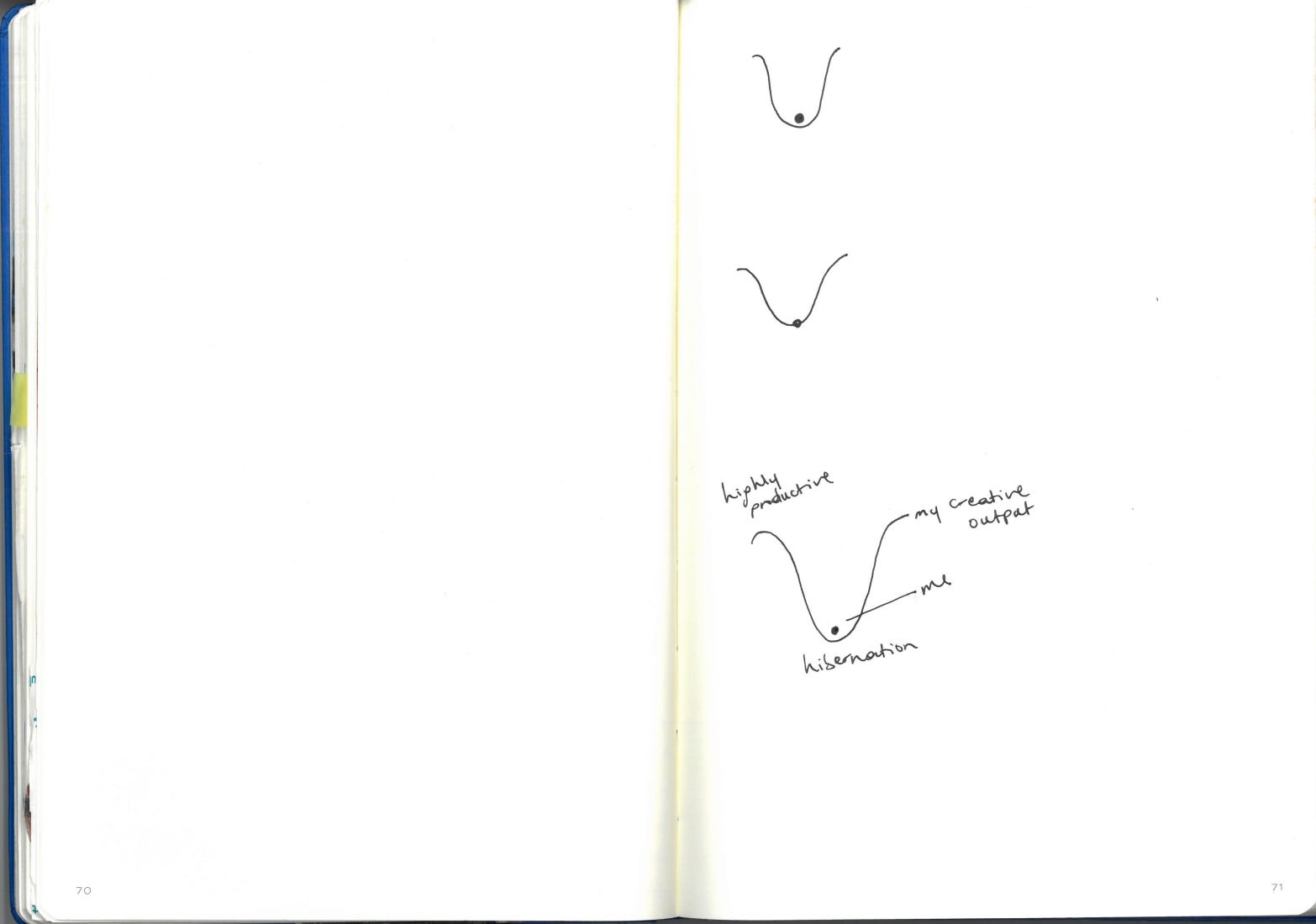
No question – that black dot was me. The line was my creative output. It was a deeply comforting feeling, seeing myself covered in duvets at the bottom of the curve. It wasn’t like being at rock bottom. It was like being at the bottom of a well but feeling really optimistic about it, because it was obvious that the climbing line marked my trajectory after this season. And since the line curved up, I could actually enjoy being there, in that cozy deep space. Waiting for the worlds inside and outside of me to bloom.
Which was a nice experience, because lately my inbox has been piled high with rejections from various ‘prestigious’ ‘magazines,’ and I’ve been wondering very seriously if maybe I’m not that good at writing after all. Don’t worry, friend – it didn’t last. I am just frustrated, confronted with the hard jut of my abilities at this point in time. Here I am, on one side of a chasm. I can see over to the other side. I can see what needs improving. I can also see that the only way to get there is to surrender, actually surrender, and jump over the edge. Because there’s no plummet, only curve. (Still I shake my fist at the sky of myself.)
I’ve gone colorblind to my own writing. When I look at my work I don’t think that it’s bad, but I also don’t think it’s anything. Possibly it’s because reading one’s own writing is a lot like listening to a recording of one’s own voice. There’s a sense of disbelief. Because here it is, the proof that you exist. What do you even do with that?
I want to write things that glow. I collaged this sentiment and hung it up in my kitchen, next to the dining table, where I see it all the time. For me it’s not about success. It’s about incandescence. That’s a much harder thing to work towards, actually. Because the motivation is selfless. And it’s much easier to be selfish and assume that the world needs to Read What You’ve Written, and if people like it there might be money. And money is obviously success!
Writing things that glow is trickier because the audience disappears and is replaced by some kind of higher entity. I’m no longer trying to match my six core emotions to yours. I’m directing my art towards the very space between my planet and all the others.
In All Fours, Miranda July’s protagonist talks about her creative work being a lifelong conversation with God. Or something like that. I can’t know for sure because the copy I read was from the library and I was only allowed to have it for two weeks because ~that’s the rule with bestsellers.~ So, even if July personally believes that her work is simply a lifelong conversation with God, that work still made her the author of a bestseller. And isn’t that so enticing? Even someone who has never read the book can look at its statistics and experience a surge of longing or envy or awe. The work, in that way, is a success. I’d be lying if I said I didn’t want it. I have not yet learned how to be selfless.
I read Água Viva on the train to Joensuu. Clarice Lispector writes with what she calls a ‘completely free flow of consciousness.’ But what I find interesting is how that book was actually in progress for years. She wrote several versions. She was never happy with it. The free flow was one of stops and starts; it was agonizing.
Earlier, on a bleak day in December I journaled for a full hour in a cafe. It was during this sesh that I had an epiphany. When I was younger I was excessively expressive. I made elaborate short films with my friends. I flailed around on stage doing improv. I stayed up late on school nights writing novels. In short: creativity poured out of me like rain. I hadn’t realized at the time, but that was what it felt like to be creatively unblocked. Creating was ultimately fun.
Somewhere as I entered my twenties my mindset shifted. I agonize not over the work itself, but the work of the work. I’ve let creativity become a thing that I need to solve, not a thing that I enjoy. Maybe that’s what happened to Lispector too, when she was writing Água Viva. Perhaps she sat on a beautiful balcony sipping rich dark coffee and spiraled about how futile it felt: letting herself be completely unblocked, spearing the fleeting fish of nowness.
It baffles me how difficult it is to create freely. But then I remember that the human body is held together by pressure and physics, close nets of muscle and bone. It’s our natural state, restriction. Restriction allows us to breathe. It’s possible to breathe without thinking about it.
Maybe all this is to say that when I was younger my creativity felt volcanic, untameable. And now magma has covered me and cooled into some kind of crust. I have to chip away at myself, to let it all be fun again.
This is what I’m working on.
xx Sidney
I cannot explain how much I loved this essay (but that is summarily unproductive so I shall try my level best to do so). You write so unusually and with such flair. Your quotations were perfectly reaped and inserted. You're a narrator who is genuinely enjoyable to follow the cognitions of and you think such interesting thoughts (bad compliment?). Thank you. <3
Truly truly thank you for this.